We are often asked what is Probate?
Some clients believe that it is some form of inheritance tax or government levy on estates.
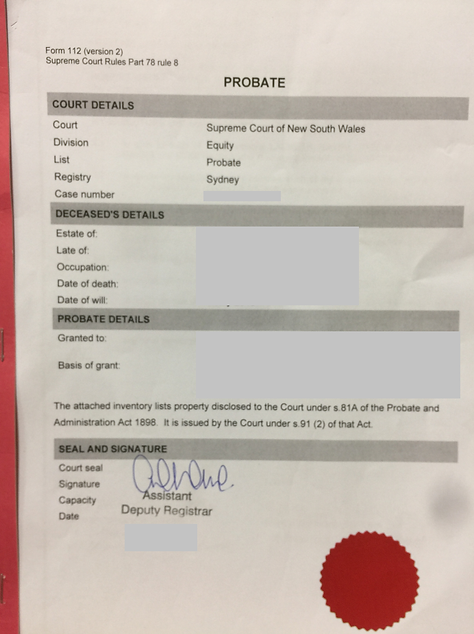
Probate is simply official recognition from the Supreme Court that an executor has the right to administer an estate according to the terms of a will. It also confirms the validity of the will to varying degrees, depending on the type of grant.
The Court’s fee for granting Probate is calculated on a scale relative to the size of the estate. For instance, if the estate is worth less than $100,000 then there is no fee. But if its worth more than $5M then the fee is about $6,000.
Is Probate always required?
No.
The question of whether Probate will be required depends on a number of factors:
- The types of assets owned by the deceased;
- how the assets are owned – solely, jointly, as tenants in common etc;
- the risks involved with the administration of the estate.
If property is jointly owned then the death of one joint owner means that the surviving joint owner(s) automatically inherits their share by the right of survivorship. This means that it does not form part of the deceased person’s estate.
For other assets, such as bank accounts or shares, there is usually a requirement for Probate set by the particular bank or institution once the value of the shares or bank account exceeds a certain level. For instance, the National Australia Bank requires Probate if the bank account has a balance over $50,000. Under this limit Probate is not required, but the Executor will have to provide a personal indemnity to protect the bank from any claims resulting from the money being released without Probate.
Probate may also be sought if there are litigation risks or if there is the possibility of a dispute regarding the validity of a will, as the executor may be leaving themselves open to personal liability without a grant of Probate.
Types of Probate – Common vs Solemn
There are two main types of Probate. A grant in common form, and a grant in solemn form.
Most grants are made in common form, and is usually handled by the Supreme Court’s registrars, as opposed to a Judge. A grant in common form is reserved for non-contentious estates, where there is no dispute about the validity of the will.
A grant is solemn form is usually sought where there is a dispute about the validity of the will. Grants are made in this manner following formal court proceedings, whereby witnesses to the will are cross-examined and sworn evidence is lead. This evidence may relate to the testator’s mental capacity or other issues which call into question the validity of the will, such as:
- questions of undue influence by beneficiaries or family members;
- questions about whether the testator knew of and approved the contents of the Will; and,
- acts of fraud.
A grant in solemn form is expensive and litigious, but once it is granted it takes the form of a judgement and is therefore much more difficult to set aside or overturn. A grant in common form is more akin to an administrative order, and may be revoked with much more ease.
Questions
If you have any questions relating to the administration of, or litigation regarding an estate in Australia, then please feel free to contact me. As a Trust & Estate Practitioner (TEP) I am a member of a worldwide body of specialised lawyers and accountants and can provide expert advice on the area.
Richard Morris TEP
Principal Solicitor
rmorris@moin.com.au
(02) 6772 4899